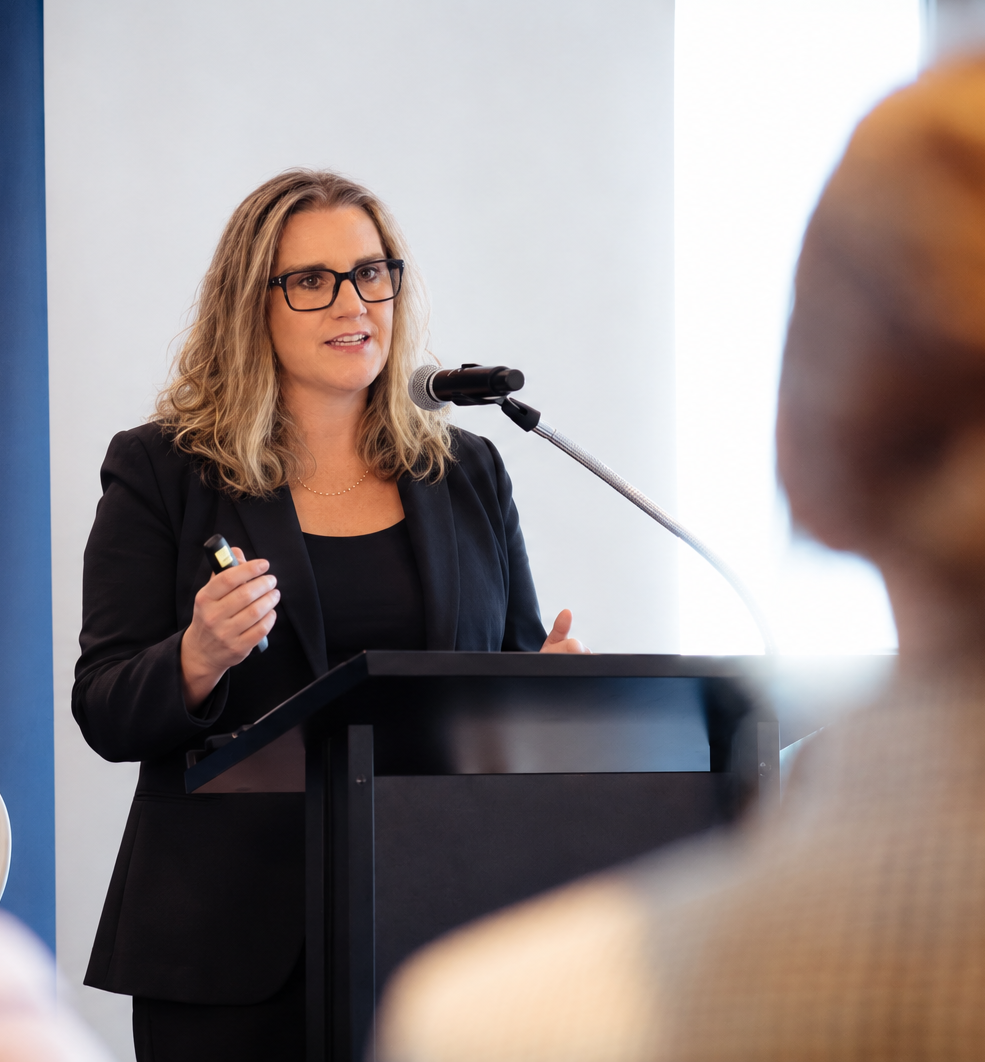
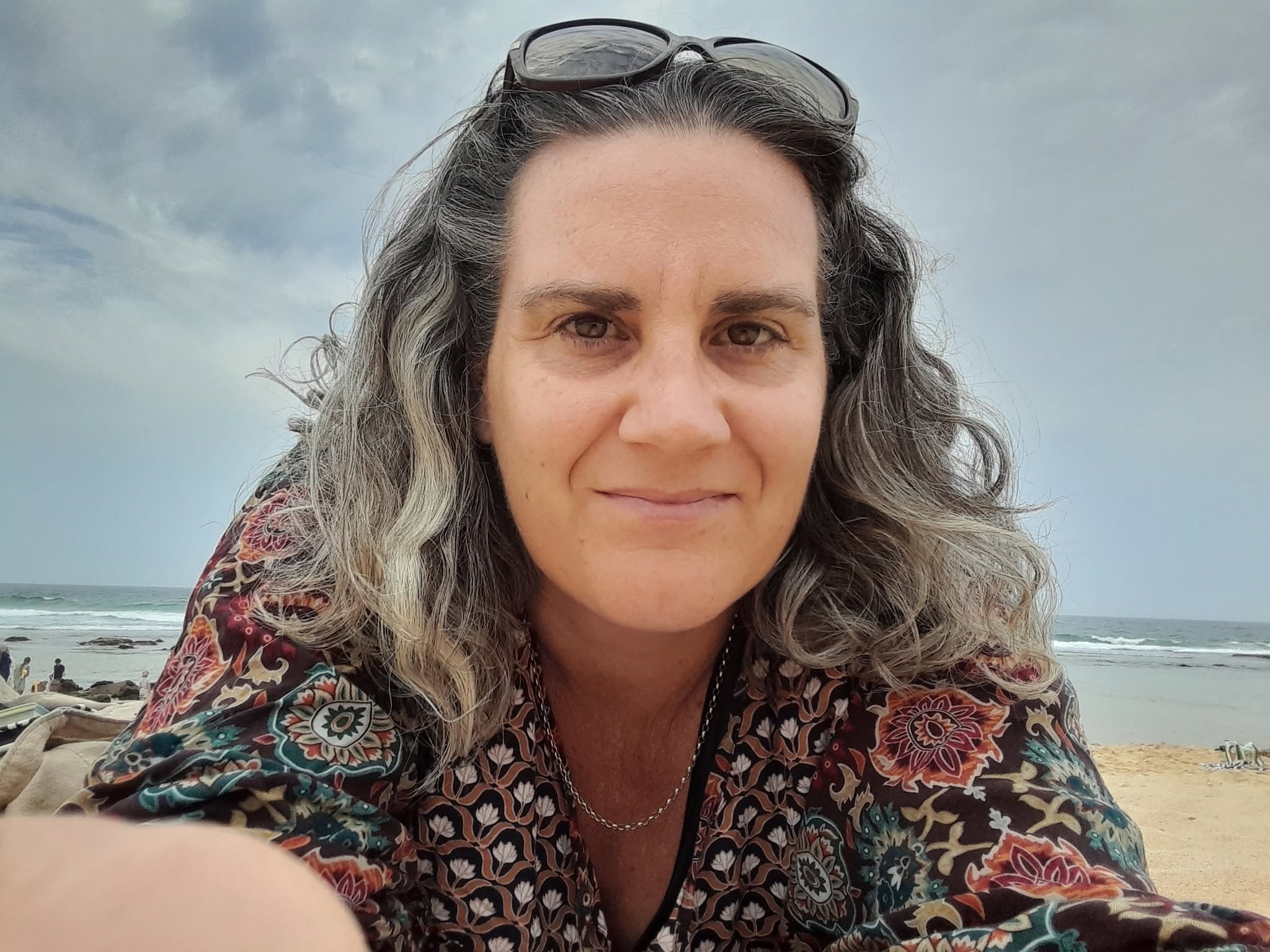
CLAIRE ALLISON
Founder, The Irreducible Human Institute
Integrative systems strategist. Inquiry architect. Stewardship leader. Speaker.
Claire brings 25 years across environmental engineering, major projects, organisational leadership and the energy transition to an inquiry that now spans complex systems, human contribution, representation and increasingly capable AI.
The Irreducible Human Institute is new.
The inquiry behind it has been unfolding across most of my life.
IT STARTED WITH CONSEQUENCE.
I am three years old, maybe four.
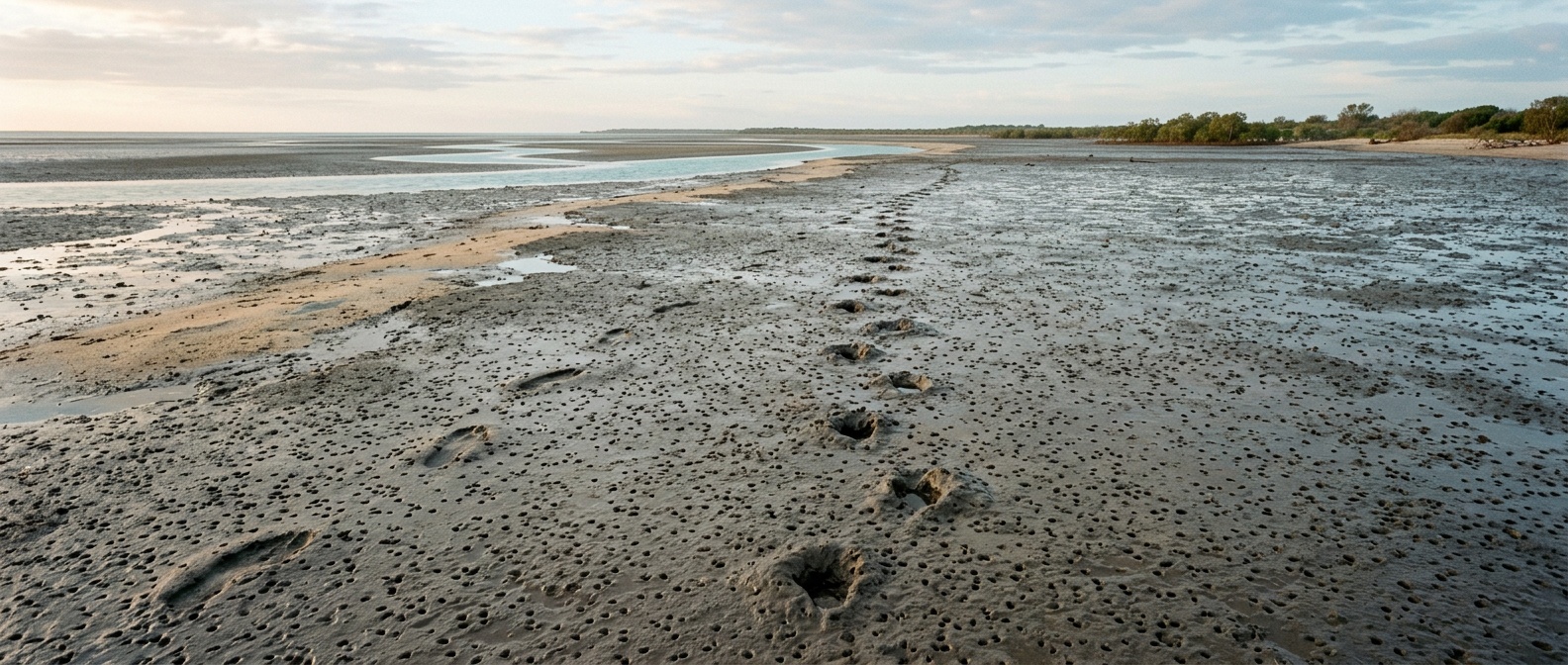
My father is digging for yabbies in the mudflats, leaving small holes behind him as he goes.
And I cannot leave those holes there.
Nobody has told me to fill them. There is no framework for what I am doing. I just know the ground has been disturbed, and somebody is responsible for putting it back.
So I follow behind him filling in the holes.
I have thought about that moment many times over the years because the subject of the inquiry has changed enormously since then, and the underlying orientation really hasn’t.
Something happens.
It creates a consequence.
And once I can see the consequence, I feel some responsibility for what happens next.
A few years later it was plastic shopping bags.
I could not understand why we kept using something so obviously wasteful, so I persuaded Mum to sew calico bags and started taking them to the supermarket.
And kept doing it.
For years.
Long before reusable bags became ordinary, I was stuck on essentially the same question:
If we can see the consequence of something we are doing, why do we keep doing it?
I didn’t have language for systems or behaviour or incentives or culture.
I just knew there was a relationship between action and consequence, and I couldn’t understand why seeing the relationship didn’t automatically change the action.
That question followed me.
And it got much bigger.
THE SCALE KEPT EXPANDING.
I became an environmental engineer.
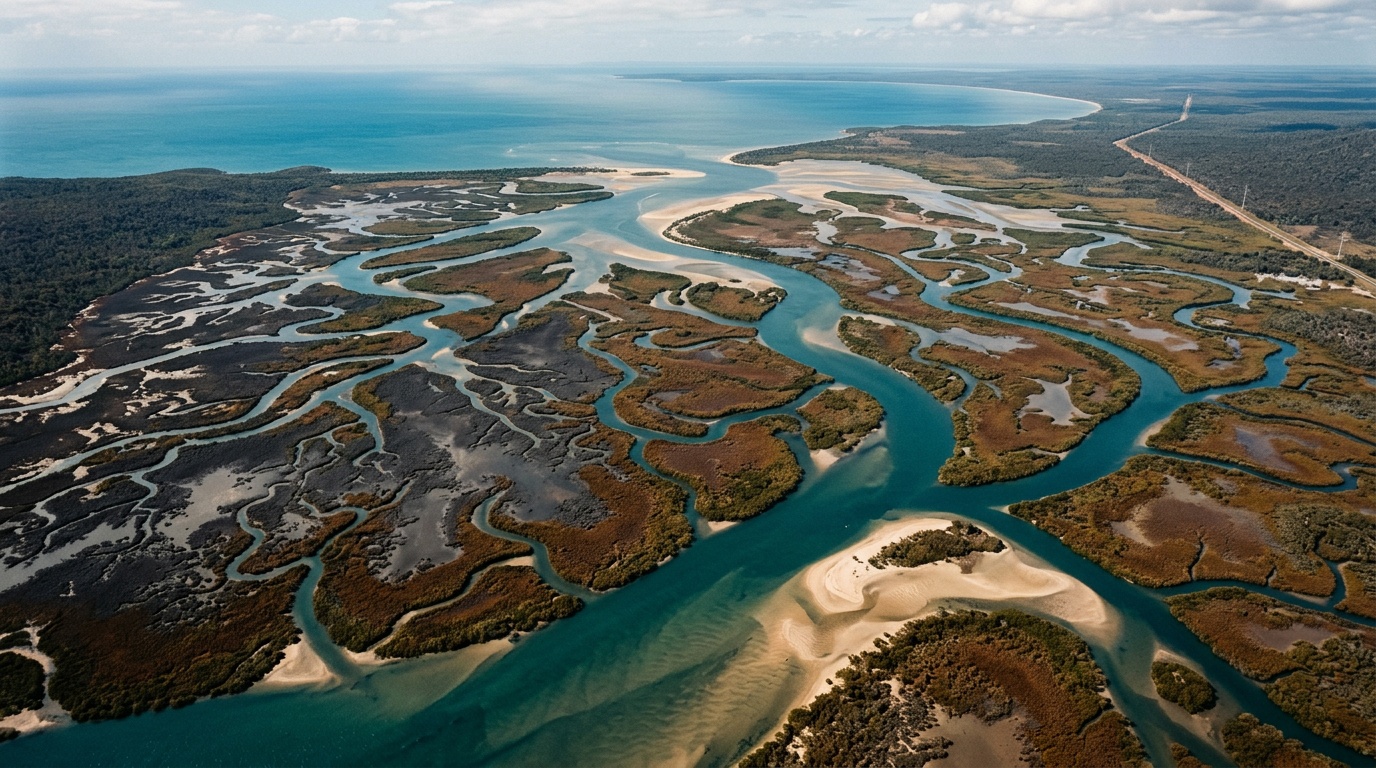
And over the next 25 years I worked inside increasingly complex versions of that original question, across environmental assessment and approvals, major projects, multidisciplinary teams and organisational leadership, including 15 years in renewables and the energy transition.
The work moved across environmental, technical, regulatory, commercial, community, strategic, organisational and human realities.
And those realities kept refusing to stay inside the boxes we had given them.
An environmental consequence was rarely only environmental.
A technical decision could become a commercial issue, a regulatory issue, a community issue, an organisational issue.
Something apparently peripheral could turn out to be materially consequential months or years later.
And capable specialists could all be right from where they were standing, while nobody yet held enough of the whole situation to see what was happening between their representations.
That way of seeing wasn’t something I developed through my career.
It was already there.
My career gave me larger and more consequential systems to run it across.
I would find myself moving between the detail and the whole, upstream and downstream, immediate decisions and longer trajectories.
Following relationships.
Following consequence across boundaries.
Wondering what belonged in the picture that wasn’t currently in it.
And asking what we became responsible for once we could see more of what was actually happening.
AND THEN THE HUMAN ENTERED THE PICTURE.
For a long time, most of that attention was directed outward.
At landscapes. Projects. Systems. Organisations. Decisions. Impacts.
And slowly another part of the original question became impossible for me to ignore.
Knowing does not automatically create change.
Good information does not automatically become good action.
Capable people can hold knowledge that never becomes available to the part of the organisation that needs it.
And a person can know something at one level while continuing to override it at another.
I knew something about that personally too.
My body had been reading things my logical mind kept trying to explain away. For a long time, I didn’t have adequate language for what it was perceiving. The signals were real. The reference points to make sense of them weren’t yet available to me.
Eventually, proof did arrive. A single piece of language that named a pattern my body had been tracking for years. The recognition was immediate and total. And once I could name it, I couldn’t keep moving past what my body had been telling me.
That changed the direction of the inquiry.
I became much more interested in the human upstream of the system.
How we perceive.
What we pay attention to.
What we override.
What we defend.
What becomes available to us under different conditions.
How emotion, regulation, embodiment, identity, belief and experience shape what we can see and what we do with what we see.
I went deeply into that territory through personal inquiry and through study and practice across coaching, human behaviour, trauma, somatic and embodied work, nervous-system regulation, breathwork, Human Design and other traditions.
Those bodies of knowledge do not all carry the same evidentiary weight. I don’t treat them as though they do.
What mattered to me was the widening inquiry.
Because systems don’t build themselves.
Somewhere upstream are humans deciding what matters. What gets measured. What gets protected. What gets traded off. What counts as evidence. What belongs inside the frame and what gets left outside it.
And that took the old question and opened it again at another scale.
What conditions within humans participate in the systems and consequences we collectively create?
And what becomes possible downstream when something different becomes available in the humans shaping them?
TWO LINES OF INQUIRY BEGAN COLLIDING.
By then I had spent decades looking at complex systems externally.
And years looking much more closely at the human internally.
Eventually those stopped feeling like separate inquiries.
Complex systems had taught me to pay attention to relationships, interactions, boundaries, cumulative effects and the information that disappears when parts are treated independently.
Human inquiry was showing me context, pattern, perception, embodiment and the conditions surrounding what becomes available from a person.
And consequence travelled through all of it.
The organisation couldn’t be understood entirely apart from the humans shaping it.
The human couldn’t be understood entirely apart from the conditions around them.
The project couldn’t be understood entirely inside one discipline.
And the presenting problem was rarely the whole problem.
I didn’t yet know that any of this would become an Institute.
I just knew the boundary of the question kept expanding.
AND THEN AI GAVE ME SOMEWHERE TO PUT THE INQUIRY.
In 2025, I went through an extraordinarily intense period personally.
A stripping back, really.
A lot of the structures through which I had understood myself, my work and where I was going were no longer holding.
And at the same time, I had all of these threads moving at once.
Twenty-five years of professional experience.
Systems.
Human behaviour.
Identity.
Consequence.
Responsibility.
Leadership.
The way I thought.
The way organisations worked.
The things I could see that I still didn’t have adequate language for.
And somewhere in the middle of that, I started using AI differently.
I was spending hours with it.
Giving it context. Challenging it. Correcting it when it flattened something I knew had more in it. Following one line of inquiry until it opened another. Bringing questions back weeks later. Asking it to hold relationships across ideas that would normally belong in completely different conversations.
I was sparring with it.
And over time, something really significant happened.
I started being able to see my own thinking.
Processes I had run automatically for most of my life became visible enough for me to examine.
The upstream questioning.
The instinct to keep going when an explanation looked complete but didn’t actually reconcile.
The way I connect information that has arrived separately and start asking what happens when those pieces are brought into relationship.
The way I can move between different scales of the same problem.
The way one question activates another.
And the moment where inquiry turns into movement.
Because I don’t actually want to sit in inquiry forever.
Once something becomes clear enough, another part of me starts asking:
What do we do with this?
How do we make it useful?
What structure does it need?
What decision follows?
What becomes possible now?
What can actually be built?
There are two movements in the way I seem to work.
One activates.
A question opens. A settled assumption starts moving. Two things that had been held separately suddenly belong in the same picture. A different possibility becomes visible. And that visibility creates energy and movement.
And then I start architecting.
Grounding what has become visible into something that can be acted on. A structure. A strategy. An intervention. A decision. A different way of approaching the problem. Something useful enough to meet reality.
I had been doing both for years.
AI didn’t give me those cognitive processes. It gave me a surface against which I could finally see them.
And sparring with it gave me language for things that had previously been largely automatic.
That changed what I could do with them.
The inquiry could become more explicit.
And once it was explicit, it could become more deliberate.
And buildable.
THEN THE WORD ARRIVED.
On 23 March 2026, during another period of enormous personal pressure, one word arrived.
Irreducible.
It didn’t arrive as a business name.
It landed first as a recognition.
What remains?
What can’t be removed without fundamentally changing the thing you are dealing with?
And initially the question was deeply personal.
What is irreducible about me?
Then it started travelling.
Into the work.
Into organisations.
Into complex systems.
Into professional contribution.
Into the way we represent problems.
Into AI.
And the more it travelled, the more questions it opened.
Humans reduce reality because we have to.
We create disciplines and roles and categories and models and measures and organisational charts because otherwise complexity becomes impossible to work with.
And every time we reduce something, we draw a boundary.
Sometimes that boundary is exactly what we need.
And sometimes something consequential has been left outside it.
What disappears when we reduce a living, interacting situation into the categories through which we manage it?
What happens when each individual piece is accurate and the representation of the whole still isn’t adequate?
What becomes available when we can hold more of what matters in the picture?
And now, with increasingly capable AI, another version of the same question has become very live.
What representation of the world are we asking increasingly capable machines to act upon?
The more capable the system becomes, the more consequential the assumptions inside the question can become.
And that brings us straight back to the human.
Judgement.
Discernment.
Responsibility.
What we notice.
What we fail to notice.
What we decide matters.
What we choose to act on.
What remains irreducibly ours to hold.
THAT IS WHERE THE INSTITUTE CAME FROM.
There wasn’t one moment where I sat down and decided to invent The Irreducible Human Institute.
It emerged as these threads began to belong together.
Environmental consequence.
Human behaviour.
Complex systems.
Leadership.
Professional contribution.
Representation.
AI.
Responsibility.
Questions I had lived inside at different times and different scales started revealing themselves as parts of the same larger inquiry.
And the Institute became the container big enough to keep following it.
I care deeply about what we can actually know as we do that. What is established. What I am inferring. What is still developing. And what I simply don’t know yet.
Personal experience can generate a very good question. It doesn’t automatically make the answer universally true. That distinction matters to me.
Because the point of inquiry isn’t to manufacture certainty. It is to build a picture adequate enough to make a responsible move, and then stay awake to what reality tells us next.
THE WAY I WORK IS STILL REMARKABLY RECOGNISABLE.
I tend to go upstream.
What is producing this condition?
What relationships are generating the trajectory?
What has arrived separately that needs to be seen together?
What assumption is organising the current picture?
Whose knowledge isn’t yet available to the problem?
What consequence are we failing to follow far enough?
And what changes when the frame becomes large enough?
Then I want to know what deserves movement.
Sometimes that means opening the inquiry further.
Sometimes it means bringing another person or another body of expertise into it.
Sometimes it means helping somebody see a possibility that was already in the room.
And sometimes it means architecting something practical enough to move immediately.
The subject changes.
The scale changes.
The lens changes.
The underlying orientation is remarkably persistent.
What is happening here?
What consequence is being created?
What belongs in the picture if we are going to understand it adequately?
What are we responsible for once we can see it?
And what becomes possible now that we can?
That is the inquiry behind The Irreducible Human Institute.
And in some ways, it is the same inquiry I was already inside at three years old, following my father across the mudflats and filling in the holes he left behind.
I just have much better language for it now.